Saturday, October 6 – 1906
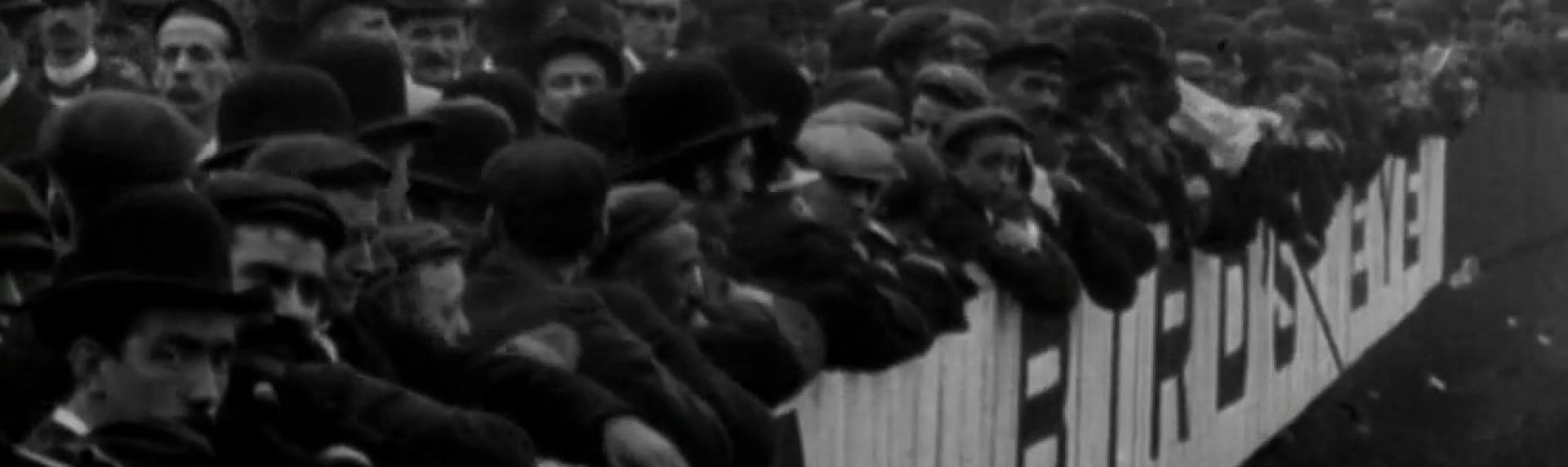
Park Avenue – Bradford F.C. football ground
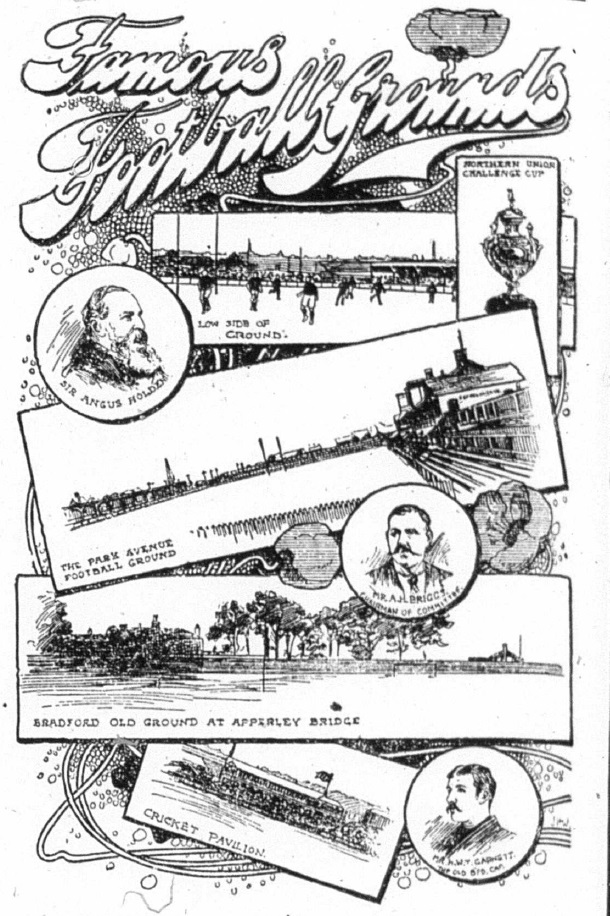
The accompanying collection of pictures forms the first of a series of illustrated articles dealing with historic football ground, which are to appear regularly during the next month or two in Saturday’s Football “Post.”
It is fitting, surely, that the series should commence with the classic ground at Park Avenue, the home of the most ancient of Yorkshire clubs, and at once the centre and the inspiration of Rugby football in the Broadacres.
The great matches that have been won and lost there, and the famous footballers who have made their reputations and flourished there, together make up a story which must be fascinating to all followers of the code in the country.
But the well-appointed grounds at Park Avenue have not always been the home of the Bradford Club. The club had indeed been in existence 17 years before Park Avenue was acquired. It was in 1863 that Mr Oates Ingham, with some fellow students from Bramham College, reinforced by others from Steeton, formed the club, which in the course of years increased in fame and numbers until, in 1880, it was possible to combine with the Bradford Cricket Club in taking over from Sir Francis Sharp Powell the site where the footballers and crickets of Park Avenue now coruscate. Meanwhile, the club had had many playing field.
At first for two winters they played on the old Bradford cricket field in Horton Lane, and in succession settled in Laisteridge Lane, in North Park Road, Manningham, at Peel Park, at Girlington, and at Apperley Bridge. In the old Stansfield Arms field at Apperley Bridge – now by a sad fate converted into a home of Socker – big crowds were wont to travel up from Bradford to witness the performances of Mr H.W.T. Garnett and his team. They formed a strong and lusty side in those days of the late seventies, and few were the teams that could get the better of them.
In 1880 the club had assumed such weight and dignity that the management were approached by the Bradford Cricket Club with a view to amalgamation, and brushing all difficulties aside, the two organisations came into line and combined under the presidency of the then Mayor of Bradford (Sir Angus Holden), with whom, as trustees, there were also Messrs J.H. Mitchell, John Ingle, Samuel Ackroyd, Henry Mitchell, Mark Dawson, Alf Aykroyd, Alfred Illingworth, Colonel Hirst, and Major Shepherd. In the deed of amalgamation it is recorded that “a sum of about £100 was named as the normal expenditure per annum of football management.” Little was it then realised that within a few years Rugby football would have so completely fascinated the Bradford public that “gates” could be attracted to bring in hundreds of pounds of profit every year.
Expenditure of the ground.
From the start the club was a success, and in 1892 – the year before a fourteen years’ lease of the ground would run out – the club completed a rare bargain in purchasing the ground from Sir Francis Sharp Powell for the sum of £13,000.
The two handsome pavilions had long previously been erected, but in subsequent years they were extended, and improvements on a vast scale were carried out in various parts of the ground, so that there has been a cost altogether on the ground of £23,000. There has, of course, all along been a mortgage on the club, but this has gradually been reduced to £7,000, and in the fullness of time, when the club shall have a series of successful season, both in cricket and football, the mortgage will be wiped out, and Park Avenue will stand as one of the finest aspects of sport in the country.
Mention of sport reminds one of certain clauses in the original lease which read strangely in these days. It was declared that “no exhibition of fireworks and no balloon ascents” should be allowed at Park Avenue, and that the grounds should never be voted to “rabbit coursing, horse, donkey, or mule racing, pigeon flying, or sports of a similar nature.”
Essentially a football, cricket, and athletic ground, these decrees have never, we believe, been violated.
As the Bradford Club has always held its head high in the football world, it will be understood that Park Avenue has quite an aristocratic name in the annals of sports. The scene in the eighties of many visits from such renowned clubs as Blackheath, Richmond, Fettes Lorettonians, Old Barbarians, Edinburgh Academicals, and the ‘Varsity fifteen, Park Avenue has witnessed many a stirring fight.
Bradford always played a “class” game – the reputation, indeed, is still held by the club to-day – and during those halcyon days of the eighties there were games at Park Avenue that thrilled and left impressions of football brilliance that have become imperishable memories.
What Bradfordians will forget the deeds of the heroes of ’84, and of those great footballers the two Robertshaws, Fred Bonsor, Ritchie, Laurie Hickson, Jack Toothill, and Tom Broadley, who have helped to make the Bradford Club what it is to-day?
The record gate.
Park Avenue is essentially a home of Rugby, and though one can never tell what the whirling of time may bring forth, there are as yet no signs that it will ever go over to the rival code. Rugby has always attracted its thousands to Park Avenue, and even so lately as March 31 last, the biggest attendance was recorded when the Bradford v Halifax Cup tie attracted about 27,000 spectators, and accounted for receipts amounting to £766 8s 10d. The previous best was £726 14s 6d, taken on the occasion of the Bradford v Broughton Rangers match of April 5, 1904.
It only remains to be added that Park Avenue has as enthusiastic a body of workers at its head to-day as ever it had. One – to name just one of many noted Bradford sportsmen – Mr A.H. Briggs, who is chairman of the committee, only recently showed his public spirit and tangible interest in the club by laying out two handsome bowling greens, which are a considerable source of delight to the members (our photograph of Mr Briggs is by Messts W.H. Parkinson and Co., Bradford.) John Jennings is still the curator and groundsman, and recently, on completing his 23 years’ service in that capacity, he received a very gratifying token of the members’ appreciation. One of his duties is, of course, to keep the cricket pitch in order, but that is a pleasant duty, for the turf at Park Avenue possesses a virtue all its own, and is famed far and wide as one of the best playing creases in England.
(Yorkshire Evening Post, 06-10-1906)
 "Play Up, Liverpool"