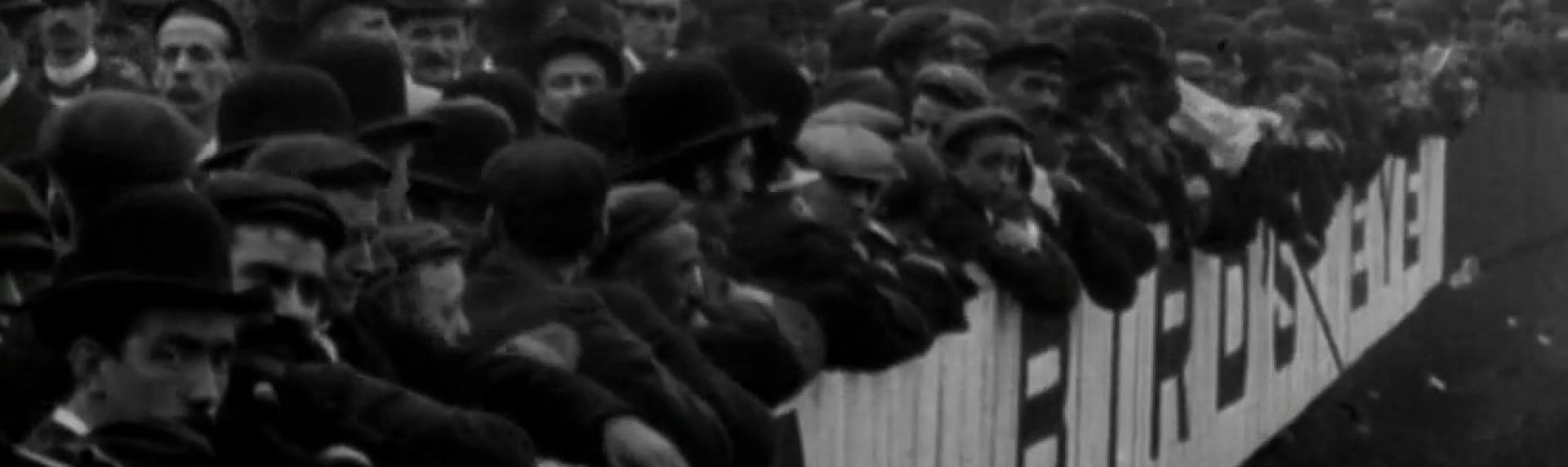

Saturday, April 8 – 1922
Match: Football League, First Division, Boundary Park, kick-off: 15:15.
Oldham Athletic – Liverpool 4-0 (1-0).
Attendance: 12,000.
Referee: Mr. H.W. Andrews (Prestwick).
Oldham Athletic (2-3-5): Ted Taylor, Harry Grundy, Reginald Freeman, Alf Marshall, Elliot Pilkington, Bill Taylor, Charlie Wallace, William Wood, Reuben Butler, Jimmy Marshall, Bert Watson.
Liverpool (2-3-5): Elisha Scott, Ted Parry, Ephraim Longworth, John Bamber, Walter Wadsworth, Donald Mackinlay, William Lacey, Dick Forshaw, Harry Chambers, Harry Lewis, Fred Hopkin.
The goals: 1-0 Marshall (28 min.), 2-0 Marshall (55 min.), 3-0 Marshall (70 min.), 4-0 Butler (88 min.).
Oldham’s honour.
First team to score four goals against Liverpool.
Football is a funny game. I claim no originally for the remark. In every sphere of sport folk have been credited with this trite sententious phrase. It is rather appropriate nevertheless to introduce the fact that Oldham Athletic, the despised – and very nearly the rejected – of the First Division of the Football League, defeated Liverpool, the prospective champions, by four clear goals. The result is at least piquant for mark you, Liverpool, in the course of thirty-five preceding matches, have never surrendered so many goals at once. Indeed on only two occasions had their defence been penetrated thrice. So Oldham Athletic enjoy a distinction apart from the fact that they humbled the most affluent of clubs.
Oldham Athletic played so well – far above the class one would expect of a club in durance vile – that had Liverpool revealed a vestige of their accustomed form the result would have been a very near thing. The contrary being the case, the League leaders were overplayed to an extent, I imagine, they never have experienced hitherto this season. The result will do the Athletic much more good than it will do Liverpool harm.
The inspiration of success.
How easy it is to succeed when one has the comforting knowledge that all is well. Give the Athletic credit for the way they tackled a serious obstacle. They cannot have a finer tonic, or one more deserved.
Liverpool were minus the services of Bromilow, and for the last quarter of an hour Mackinlay, who, small blame to him, had failed to accommodate himself to the left half-back position; was off the field, I mention these circumstances in passing; not as an extenuation.
The Athletic attacked with all the spirit born of desperation, and Elisha Scott made a save from J.H. Marshall that only the greatest of goalkeepers is capable of. So far as shooting is concerned, however, this was merely a diversion on the part of the Athletic.
Liverpool’s tentative raids invariably produced something direct on the target. Assuredly, they were very tame attempts Ted Taylor picked the ball up from the ground with consummate ease, save when he made the best shot from a Liverpool boot, that of Lewis sailing for the angle of the goal, look easy.
It was largely thanks to the fine goalkeeping of Scott, some haphazard intervention by the Liverpool defenders, and some very feeble attempts by the Oldham forwards, that the score sheet was blank until the twenty-eight minute. Then Wallace passed square across to J.H. Marshall with such force that it rebounded from the roof of the net to the ground at a tremendous pace – a truly a great goal.
Now Marshall, who has been out of luck on the football field and a silent sufferer in his domestic affairs – would be barrackers please not, for even footballers are human – was wonderfully heartened by this success. I could see it immediately in his play.
By this goal the Athletic led at the interval, and eschewing the ornate on the heavy turf they kept the game very open and resultantly full of life and movement. Liverpool’s defence was now unquestionably oppressed to the limits of endurance.
Butler gravitated to inside right, and J.H. Marshall did the only possible thing to gain a goal under the circumstances by applying his head, very low, giving Scott no hope.
Taylor (E.) was lucky to escape through a stab-shot from Chambers hitting his foot. Nevertheless, the Athletic had so much command of the game that they always looked like adding to their score. Again Marshall was the emergency man in front of goal, for he hit a pass by Butler into the net first time. Wood and Watson came near emulation, but they lacked Marshall’s decision in front of the posts. Finally, near the finish Wallace provided Butler with the wherewithal to make the victory surprisingly emphatic.
Worthy of a brighter future.
The indelible impression left by this game on my mind is that Oldham Athletic are too good to go into the Second Division. I speak for this game alone. Ted Taylor was a good goalkeeper, as he always is, without being given the chance of demonstrating his real prowess. I have seen Freeman to greater advantage. The importance of an occasion seems to deter him from playing his natural game. He was so patently anxious that he kicked without left and lost his position also. The direct methods of Grundy were more effective.
Oldham’s half-backs were a hard-tackling company – the tenets of destructive play, no doubt, being the result of repeated experience of persistent opposition attack. But Elliott Pilkington held the ball well, and uncovered his forwards before releasing it with discretion. There was no better player on the field. Marshall (A.) and Taylor (W.) certainly contributed their share to the shattering of the Liverpool forward machinations.
In generalities the forwards were on a level, but Marshall must be singled out because he had the faculty for shooting which none of his colleagues revealed to any creditable degree. Butler is clever enough to work openings, but does not part with the ball, as surely he can, to advantage. Wood, the young inside-right, is certainly going to develop into a really serviceable player; so is Watson when he overcomes the tendency to over-run the ball. Wallace indicated all the attributes of the first-class wing player save a tendency to waste balls behind the goal when he had plenty of scope to put them in front.
To criticise Liverpool at any length would be an injustice to their merits of the past and the position they have attained, Scott enhanced an already unimpeachable reputation, but I have seen both Parry and Longworth more intuitive in tackling and more judicious in their returns. The former’s future in senior circles is already assured, however.
Liverpool lacked their vaunted strength at half-back, Bamber has not recovered his form, that is, judging him at the high standard he set for himself. Mackinlay I have referred to. Wadsworth, in the centre, was not his commanding self.
The forwards never harmonised with their accustomed balance. Lacey and Hopkin on the wings were spasmodic, just as occasion offered. With more chances the latter did well. The inside men were merely fugitive. Chambers got few good passes, and Lewis and Forshaw were artistic without being mobile assistants to their wing colleagues.
(The Athletic News, 10-04-1922)
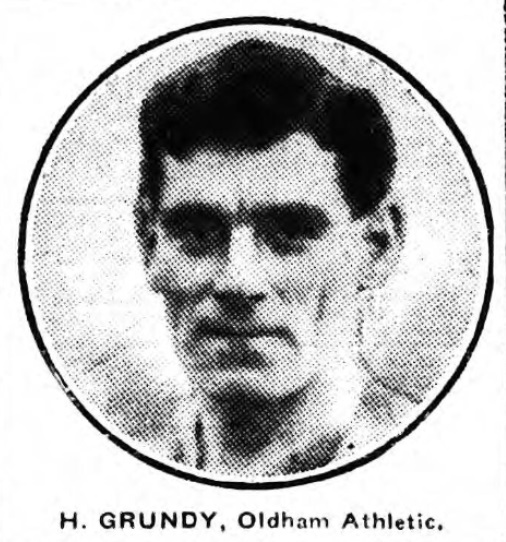
Harry Grundy, Oldham Athletic F.C.
XX
 "Play Up, Liverpool"