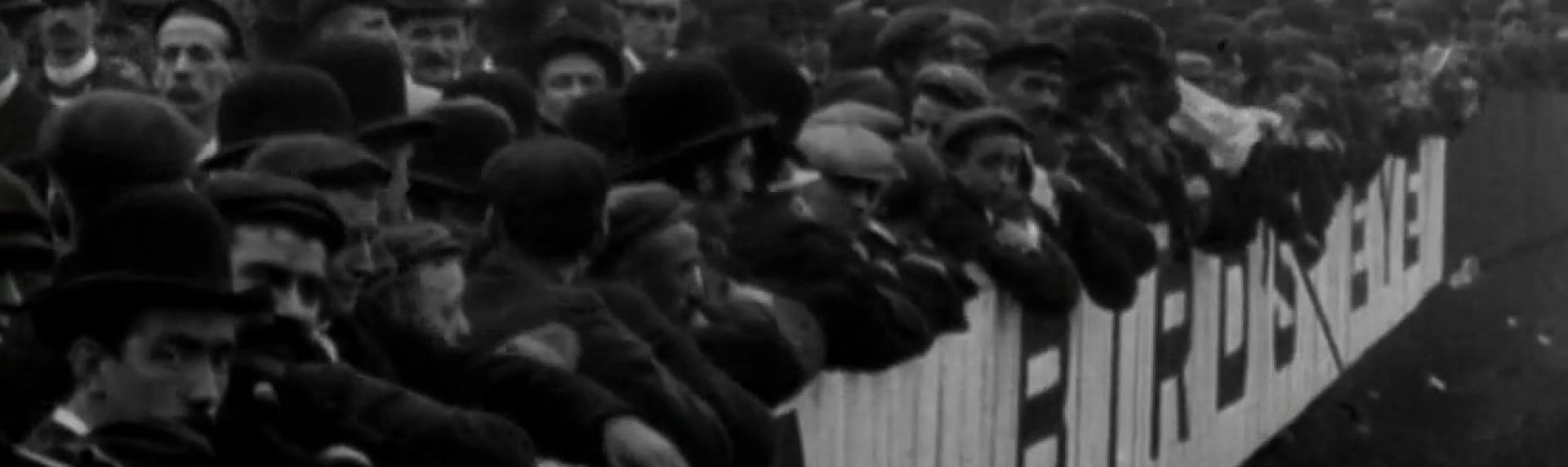
On September 27 it is 130 years since the first football match was played at Anfield. The year was 1884 and Liverpool F.C. were still eight years away. The occupants of the ground was Everton F.C., and on this Saturday they met Earlestown at their new ground in “Walton Breck-road.”
This article is about the history of the Anfield football ground, and it starts with Everton.
On September 20 – 1884 the “Liverpool Courier” wrote: –
“Hereabouts grounds are becoming more difficult of access year by year, and from present appearances it is evident the day is not far distant when football, in common with other pastimes, will be confined to the public parks.
“Even Everton, the Liverpool cupholders, found themselves homeless at the commencement of the season, but were fortunate in securing temporary possession of a building site in Anfield-road, which is being enclosed at considerable cost.
“The ground is easy of access, being in close proximity to the “Sandon,” the headquarters of the club; and as it admirably suited to the pastimes, it will doubtless be the most popular of our local grounds during the winter months. “
Try to imagine that you are being part of a local community that are developing a football ground from scratch? Neighbours and friends bring their carpenter skill, their electrician skills or their gardener skill around. Painters and cleaners; and the ones organising – not forgetting those trying to hide away.
Such an imagination might sound too romantic, but I do think it must have been something like this when the members of Everton Football Club came together in the summer of 1884 to build, and raise, their own football ground; the ground that we today know as Anfield.
It would have been the most extraordinary, magical thing for the local people to see a transformation like this. This was their creation to the ever growing British football family.
They were living at a time when the football palette was dominated by teams from neighbouring towns in Lancashire, the south and Scotland. They also wanted a piece of the cake.
Something as flamboyant as your own ground would give this particular area a real local signature. Something that would have meant “this place” to the people. A place where memories and tradition would start, where songs and opinions be shared, and victories won and celebrated.
Having spent the last 10 years searching old newspapers to get a better understanding of the history of the football club I will try to piece together the early story as I understand it.
There are of course many small mile-stones in the history of Anfield. The original stadium, the new stadium in 1906, the roofed kop and then the changes after the war and ending becoming an all seated stadium.
In this article I will look at the development of the stadium from 1884 until 1907. I will try show you with images and notes from newspapers how it has changed over the years, even the smallest details.
So, where do we start?
Let us have a look at the patch of land that the football ground is built upon. Here are some maps leading up to 1884.
This is a copy of a map of the area from 1863. We can cleary see that it was not buzzing around the place at this time. Stanley Park is not even created, and there are a few houses to the west – the area called Rockfield, or Belle View.

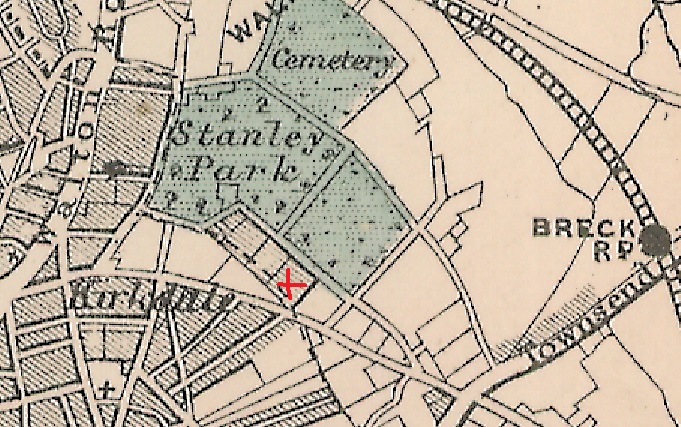
Moving on to a map from 1880 and I have marked with a red x where the ground is today. We can clearly see that Stanley Park is up and running and that the settlement in Kirkdale is moving ever closer. I assume that the open field then was used as a cricket ground with very small features, maybe just a small pavillion. Reports in media also tell us that the space between Walton Breck Road and where the Kop is today was a place where circus shows would set down their waggons. The ground itself was described as immense “muddy.”
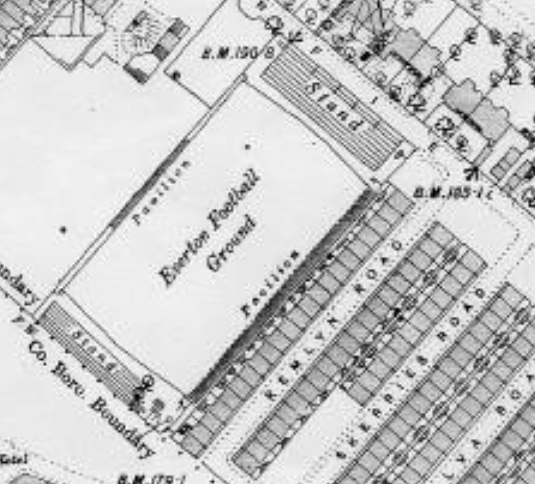
Moving along until 1890 and we now have two maps to show, and one of the maps include the “Everton football ground.” Note the small pavillion where the main stand is today, how small the Kop was then and that it seems to be some kind of entrance, or opening, at the right hand side of the Kop. Also note that the people living in Kemlyn-road had the pavillion stand in their “gardens.” And of course the Anfield-road stand which seems to be the most impressive one at this stage.

So from 1890, let us go back in time again and look at some ads in the local newspapers selling land to build upon.
This ad from 1852, specially “lot 4” seems very interesting. If this is the land the football ground is upon today this land used to be known as “Front Field.”

This ad is from March 1870 and could very well be mentioning the plat of land the football ground is on today.

I have not found any ads connected Mr. Orrell to the land before 1884. Then in the summer of 1884 we know from articles things take a change. We know that Everton Football Club is not making any financial progress with their ground in Priory-road and at some stage during the spring of 1884 the club decided to rent the ground at Anfield.
In this article we are clearly told about the circumstances for the move, and how the ground was put in order during the summer of 1884: –
“Fortunately at this period influential friends of the game and the club came to the rescue, and the permission was given the members to play on a piece of waste land lying between Anfield and Walton Breck-roads, on condition that a benefit match should be played annually in aid of the Stanley Hospital.
“It became necessary to enclose the ground from entrances and exits, and remove a large quantity of rubbish in order to make the ground fit for play. This cost a large sum of money, which was entirely subscribed by the old members and their friends while some of the more skilful gave their valuable aid with shovel and saw and hammer.
“Not a single penny spent in the erection of the first stands, boarding, fencing &c, came out of the funds of the club. With a suitable and convenient enclosed ground the gates began to increase, but even at that time £20 to £25 was considered very good, and £40 was wonderful.”
And after the 1884/85 season had ended another threat appeared. We go to the same article again and reads: –
“By pursuing a strong policy, enrolling new members, engaging clubs of renown, such as the Rovers, Burnley, Bolton Wanderers &c, to give exhibition matches, securing good players, the executive were soon able to welcome an increase of public interest, and at the close of that season the club was in a satisfactory financial position.
“About this time the executive had to face another difficulty; the ground so kindly lent them was in the market to be sold for building, and it was felt that unless something could be done to secure the ground for the use of the club a collapse would be inevitable.
“Many anxious consultations took place, inquiries were made as to other grounds, meeting after meeting was held, and, amongst other things, a company was suggested. The capital raised, however, did not give much encouragement, the amount being somewhere about £11.
“At this juncture Messrs Barclay and Jackson, who for some time had cordially worked together for the welfare of the club, arranged to approach Mr John Houlding and ask for his aid in the matter.
“The bold suggestion that these gentlemen made to Mr Houlding – that he should purchase the land, and rent it to the club – was carefully considered by him. He was naturally taken aback by their proposal and his inquiries as to security&c, only elected guarded replies.
“Mr Houlding asked what rent the club would pay? The answer was that the club might see its way to £100 a year.
– Do you know the cost of the land?
– Yes.
– And you advise me to purchase it at the cost of nearly £6,000 with the prospect of having only a return of £100 per annum, and no security that even that amount will be paid to me. Is the club, or any responsible member of it, prepared to lease the ground if I buy it?
“Messrs. Barclay and Jackson could give no assurance. They simply threw themselves on the generosity of Mr Houlding, who, whilst giving them no hope, promised to think carefully over the matter and give a reply at an early date.
“And now let it be known to those who knew it not before, how the ground was secured, and who saved the club from complete collapse.
“Not withstanding that there was no security, that the land at that time was a bad investment, seeing that the same land is now valued by his detractors at 3s per yard less than he paid for it, that the club had not a penny in the bank, that it involved a large expenditure of capital which could have been spent to infinitely better account; that he was placing himself at the mercy of the members, who might if they chose leave him at any moment, Mr Houlding bought the land, and placed it at the disposal of the executive.”
During the 1928/29 season Mr. Thomas Keates wrote “The history of Everton F.C. 1878/79 – 1928/29”. In this book this is written about Anfield, and the summer of 1884.
“A hoarding of boards was fixed on the walls, and rails around the playing pitch. Spectators stood on the intervening sods, a very humble stand crouching on the east for officials, members, pressmen, and affluents.”
The stand to the east means towards Kemlyn-road.
Over the next 12/18 months big changes appeared within the enclosure. The small stand allready mentioned was moved across the ground to the west side (Main Stand) and new pavillion was erected towards the Kemlyn-road houses.
A good story from the press appeared on march 8 – 1886 in the Liverpool Mercury. The football ground was covered in snow and the directors of the football club pust up placards in the area asking for help from 100 men to clear the ground for snow so a scheduled match could take place. The problem was that more than 100 volunteers appeared. When 100 had been selected a a snowball war started with the lot not being selected being the provocators.
Later in 1886 the first stand at the Kop end, or the Oakfield-road end saw its completion. In 1887 another stand was raised in the Anfield-road end of the ground.
We know that the Oakfield-road stand had room for 4,000 spectators and that it costed £1,500 to complete.
In a sports paper called the “Football Field” on December 28 – 1888 we get a first description of the ground: –
“The enclosure now bears the resemblance of a huge circus, with its two immense galleries, rising tier above tier, and its covered stands stretching the length of the ground on one side, and for greater part of that distance on the other. Every inch of available space was utilised, and the spectacle was of a most imposing description.”
In March 1889 Anfield was the venue for the international match between England and Ireland. 4,500 spectators gathered which gave a gate recipt of £120. On good days Everton could attract crowds up to 15/20,000.
We get a confirmation about this in the Liverpool Football Echo on November 16 – 1889: –
“At each side are large covered stands, behind each goal are other stands holding nearly 4,000 each; and taking all the stands together about 12,000 have a good view of the game from them; while another 6,000 have the same from standing room on the ground.
“Notwithstanding this, the spectators are almost inconviently crowded, and gates of nearly 20,000 are not altogether unknown.”
When Everton played Preston North End in November in 1889 the following was reported in the “Cricket and Football Field” about an almost accident at the Oakfield-road end: –
“When the battle waged close to the posts the occupants of the top rows had a difficulty in following the movements of the twenty-two units struggling below, and so they leaned forward on their fellows in front. These in turn threw burden on the lower rung, until layer on layer was piled on the bottom supports. These being but human gave way, and the whole pile fell forward like a house of cards. It is a wonderful fact that with so many hundred involved in the crash that only one small boy was hurt, and he appears to have been sitting beneath the hoarding when it fell.”
A sketch of the situation described above:-

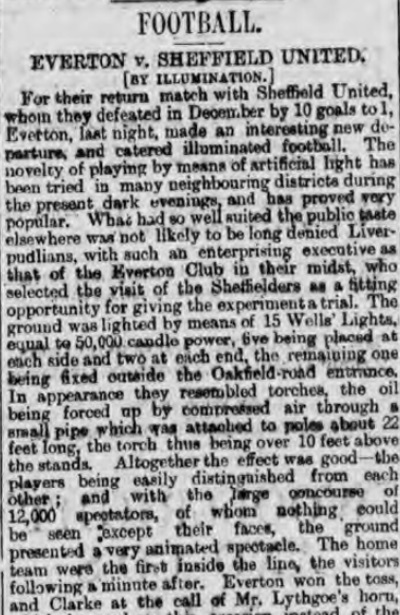
We must also take note that when Everton played Sheffield United at Anfield on January 8 – 1890 floodlights were used for the first time at the enclosre. More of this event here: –
I have found some sketches from matches at Anfield and they show the hoarding behind the goals. From when Burnley visited Anfield in January 1892, source: Burnley Express: –
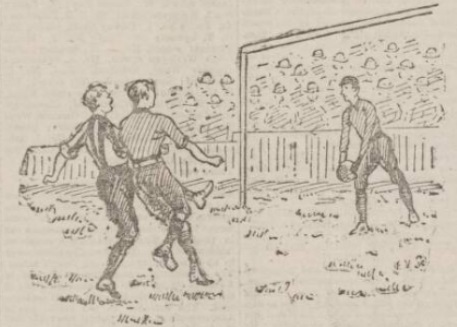

Two weeks after the League match Everton and Burnley met again, at Anfield, in the FA cup. Also here Burnley Express made a sketch, and this sketch is quite amazing because of what you can see in the background: –

I believe we see in the direction of Walton Breck Road, so the goal in the background is in front of The Kop. If it so the house to the right where the smoke is coming could be the Albert Pub.
The cup match was abadonned and replayed a week later – also that at Anfield. Guess what the editor of the Burnley Express asked their sketch artist to do that Saturday? “Head to Anfield” of course. These are sketches he made from the replayed match on 23 January, 1892: –
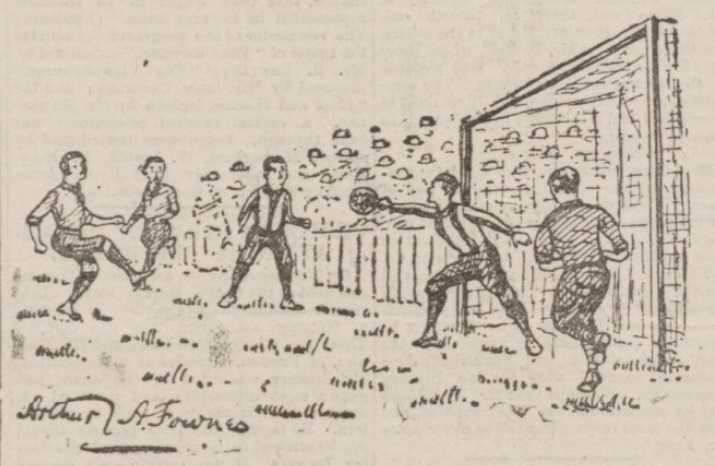

Now, this last sketch is quite impressing. It shows a Burnley attack on the Everton goal, and Everton are defending the Anfield-road end. In the background you can actually view part of John Houlding’s home “Stanley House.”
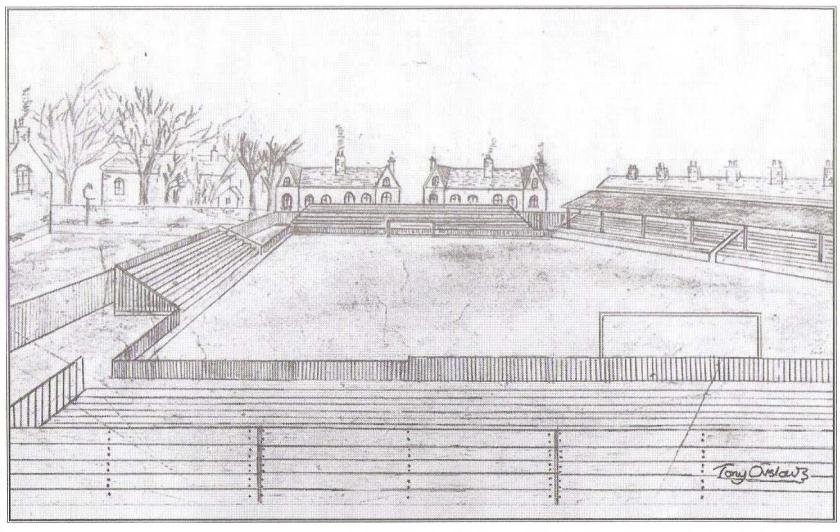
In 2002 a book came out named “Everton F.C. – The men from the hill country.” This book contain a sketch by Tony Onslow. He has pictured Anfield how it looked in May – 1892.
This is a painting of Anfield around 1892 by Marie Smith.
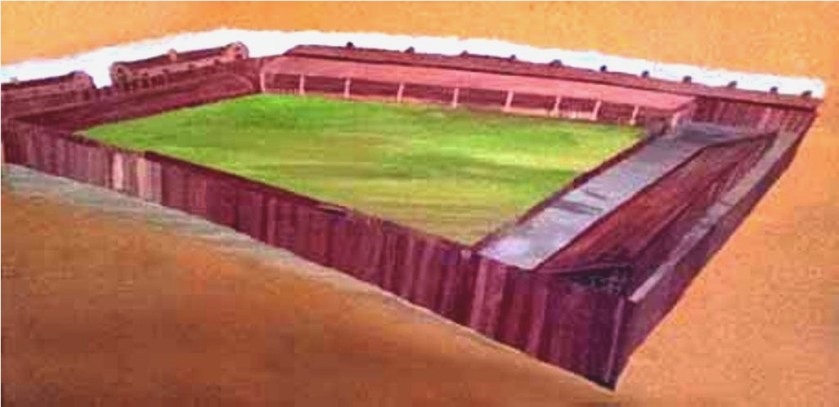
And, that is what Anfield, most likely, looked like when Everton F.C. and John Houlding & co. went seperate ways.
During the spring of 1892 the Everton Football Club split up and after the last match was played on April 30 – 1892 – the ground was empty. A legal battale about the stands and fixtures within the stadium came up in the court, and the court ruled in favour of Mr. John Houlding. The Everton club that moved out could not take anything with them.
From now one – it would be all about Liverpool Football Club.
On March 28 – 1892, “Field Sports” reported that: –
“Arrangements have also been made to secure Mr Orrell’s land, and in that event the position of the goal posts will be changed so as to remove the spectators a little further from the field of play.”
The same paper reported on June 20 – 1892 there is a letter to the editor, signed W.E. Barclay (Liverpool F.C.’s first secretary/manager). The part of the letter that is about the ground reads: –
“Subscribers’ tickets will be ready in a few days at 7s, 6d, 15s and 21s, according to accommodation, and the prospects are very bright, and I anticipate a very satisfactory season on the old ground. Although we are the Liverpool club, all the old playing members of the old Everton, to whom Evertonians are much indebted for promoting the game in our midst, have been elected hon. life members. The plans for the dressing-rooms, gymnasium &c, are now under consideration, and visiting teams will be spared the trouble of dressing away from the ground, whilst our own players will not only have a clubroom, but admirable dining-rooms and training quarters at the ground.”
A week later in the same paper information about the ticket prices at Anfield for the coming season appeared: –
“The admission to Lancashire League matches will be 4d, and to Liverpool and District League Matches 3d. Subscription Tickets will be ready shortly at the following prices:
To Ground and uncovered Stands…..7s 6d
To Ground and covered Stands…….15s 0d
To Ground and Reserved Stands…..21s 0d.”
Then on Wednesday, August 12 – 1892 – Liverpool F.C. had their first training session at Anfield. It was open for public and 6,000 people turned out. Field Sports reported that the club had fixed dressingrooms at 27 Kemlyn Drive. On print it said: –
“The Liverpool Executive have taken and rented, as a dressing-room, a house, at 27 Kemlyn-drive, the backdoor of which adjoins the players` entrance to the ground, and it contains ample bath and other accommodation both for visitors and home players. The services of three competent trainers have been placed at the disposal of the committee, and the one finally selected will be placed in charge of the dressing-rooms.”
On February 10 – 1894 the first real attendance record for Liverpool was set at Anfield when 17,000 spectators turned up to watch the FA Cup, 2nd round tie with Preston North End. Liverpool Mercury wrote after the game that hundreds of people were turned away from the gates fifteen minutes before the game started. The gate receipts amounted to £460 which was also a new club record.
In early June 1894 the news about Liverpool F.C. leaving Anfield hit the press. “The Athletic News” wrote: –
“The Liverpool FC is face to face with the same difficulty as beset the Everton Club, and which led to the latter club going to Goodison Park. As most people know, the Liverpool ground is cramped for room, and would be to the extent of ten yards more if the landlord of the adjoining land cared to insist on his right.
“We don’t know that he is bent on putting his claims to the full, but the Liverpool Club want to secure the land and the owner’s price is really exorbitant and cannot be entertained. That is how the case stands at present, but the Liverpool Club have taken the precaution of securing another ground thus early.
“We don’t know whether there is any secret in its locality, but it is on the Old Swan tram line, and is easily accessible by rail – in fact, in this respect it is better situated than even Goodison Park. Of course something will have to be done for the accommodation of spectators, and if the worst comes to the worst this will be accomplished. Still, if the club can possibly come to some arrangement they will stay where they are, but matters can be pushed too far.”
Three weeks later the matter was solved when Liverpool F.C. came to terms with Mr. Orrell. “The Athletic News” reported: –
“While the Everton shareholders were up in arms, the Liverpool directors were quietly concluding agreement with Mr Orrell, the owner of the land adjoining their ground. This means that the Liverpool Club will remain at Anfield, and today will see the commencement of the improvements of the ground. These will comprise the erection of additional stands on what is known as the old stand side and the land taken in will allow plenty of scope for the undoubted energies possessed by the executive of the Liverpool Club.”
When the football season 1894/95 came around the “Liverpool Mercury” wrote a superb preview of the Liverpool club. About Anfield they wrote: –
“In anticipation, and rightly so, of great increased attendance, the committee have worked a great change upon the ground. The improvements and alterations have completely varied the aspects of the old Anfield ground. About the only fault which could be found with the ground – in being too narrow and cramped on either side and the inadequate means of exit – is now entirely removed, but owing to the brief space of time at the disposal of the club, the arrangements are but of a temporary character, and will be thoroughly carried out next year.
“With this view in mind, the new grand stand which has been erected upon the land lately acquired from Mr Orrell is so built as to be easily removed when the occasion demands. It is a really handsome and commodious building. It measure 360ft long, and has eleven tiers of seats, beside a balcony at the back 4½ft in width, and is computed to seat 3,000 spectators comfortably.
“The roof has been placed so that even when standing up in the balcony at the rear every portion of the field is visible. The space between the stand and the touch line is occupied by a platform of three rows of good width, and is estimated to accommodate close upon 2,000 spectators.
“The total capacity of the ground now is reckoned at about 25,000. Had time permitted, the goal stands, like those of Goodison Park, would have been covered over, but it has been decided to postpone that improvement. It may be safely stated that the directors of the two leading local clubs have shown an enterprise and go-ahead persistency worthy of all praise as having placed the seaport city in possession of undoubtedly the two finest grounds in the country.”
In the season review for the “Athletic News” end of August 1894 it was said: –
“The Anfield-ground has been improved, the playing portion being widened about eight yards, and a commodious stand erected. Some people say it will be the best stand in England. It is certainly a good one, both for comfort and seeing the game.”
This is what Anfield looked like in the summer of 1894.

And a sketch of the Main Stand.
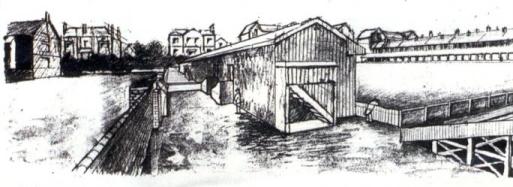
On Saturday, September 22 – 1894, Liverpool played their first home game in the 1st Division of the Football League. In the match report in “Liverpool Mercury” the newspaper again wrote about the new features with the football ground: –
“Recognising the loyal support their patrons have accorded them, the Liverpool Executive Committee are sparing no trouble or expense in fitting up extra accommodation and other facilities, which will add to their supporters’ enjoyment of the great game. New stands have been erected at the corners of the ground, and it is rumoured that ere long the end will be covered over, so that, however bad the state of the weather may be, the spectators will all be under proper cover. This will be a boon the Liverpool public are bound to thoroughly appreciate, and in return the club’s exchequer will not give cause of alarm to the hard working and earnest body composing the directorate.”
Liverpool had a nightmare start to life in the top division. One of the highlights’ of the season was when Everton visited Anfield in November 1894. This was Everton’s first visit to Anfield after the split in 1892. Close to 30,000 spectators crammed together to get a view of the 22 players. The game itself ended in a 2-2 draw, but Liverpool could not save the season. After defeat in a “test match” decider against Bury – they were relegated.
After the relegation to the 2nd Division in 1895 big question marks hang over the future of the club. The heavy ground investment from the season gone by could not justify matches with the second best teams in the League.
During the summer of 1895 two items of interest came on the directors’ table. It was decided that only the main stand would be set aside for season ticket holders, while, as the “Cricket and Football Field” could tell: –
“The rest of the ground, covered stand included, may be occupied for the nimble tanner.”
The other important new feature was the introduction of the stewards’ system. Most other clubs had allready started using the stewards’ system at this point. The club directors’ send a request to 80 of its supporters and 75 of them replied back that they would accept the role as a future steward at Anfield.
When reading through match reports from the first four seasons one cannot noticing that seven, or eight, out of every 10 matches were played in horrendous weather. With the club’s success over the first few years the team got their first real nickname in media in the mid 1890s when Liverpool Mercury started calling them for the “mud larkers,” owing to the fact that the team dug out victories on the most muddy grounds in the kingdom.
Before the start of the 1896/97 season the directors’ decided that a season ticket should cost 10s. 6d. for the uncovered portions of the ground, while the more “posh” supporters could sit dry and well for 21s. at the main stand.
To show what life would be like around a match at Anfield in 1896 I have found a couple of articles describing the scene. the first goes: –
“Joseph Waddington, coachman, living in Victoria-square, was summoned for driving four horses and a waggonette on the wrong side of Oakfield-road on the 26th September.
“Police-Sergeant 7 G said the defendant, after waiting in a side street to take a private party back from the football match on the date named, drove into Oakfield-road on his wrong side, blocking the traffic, which was then very heavy, and causing considerable danger.
“Defendant said that there were seven or eight omnibuses standing in a line, and he drove round them to get to this proper position at the conclusion of the match. – A fine of 2s 6d and 2s 6d costs was imposed.”
Then in November 1896 there is an application from a pub next door the ground. You might have guessed which pub we are talking about, the address reveals the identity, I would think: –
“At the Liverpool Transfer sessions, on Thursday, an application was made by Mr Lewes, on behalf of Thomas Taylor, licensee, for permission to effect alterations on the licensed premises, 185 Walton Breck-road, whereby a staircase would be removed and a window would be opened into a lobby of the house.
“Mr Lewes explained that the premises were close to the Liverpool Football Ground, and there was always a great rush of people to the hotel during half time. The passages became blocked with the number of people, and the customers frequently invaded the staircase, which it was proposed to dispense with.
“The opening of the window would facilitate the serving of customers, and would be utilised only on Saturdays. Superintendent Tomlinson said there was no objection on behalf of the police. He had visited the house at half time, and it was like “Bedlam.” No doubt the new window would facilitate matters considerably. The application was granted.”
The article is of course referring to the premisses of The Albert.
In June 1897 the “Cricket and Football Field” mentioned that: – “Liverpool’s new grand stand has been so constructed that it may be removed. The cost will be something like £120, but Mr. Rutherford, the builder, can easily bring it back, and thus have ample space for the proposed new cycle track.”
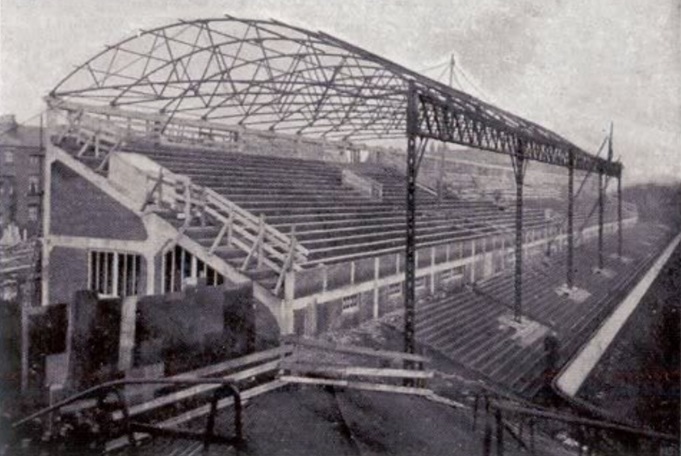
I assume this photograph is showing the stand at Kemlyn road around the turn of the century.
And, in the same note section we find that: – “The Liverpool Committee are emulating their local confreres and putting their turf in order. The holes have been filled with new sods from Mr Orrelll’s land adjoining, and already the grass is showing itself as if it will soon want its hair out.”
You might wonder how the ground was kept in order during the summer months, specially the turf? This little ad in Liverpool Mercury from July 1897 give some indications: – “FREE GRAZING for sheep. – Apply, stating number, to Mr. Watson, Liverpool Football Club, Anfield-road, Liverpool.”
Before the start of the 1897/98 season Liverpool Mercury again had their season preview. This was said about Anfield: –
“In anticipation, and rightly so, of a greatly increased attendance, the committee of the Liverpool club have worked a great change on the ground.
“The stand adjacent Anfield-road has been covered over, and in unfavourable weather it is estimated that there will be covered accommodation for close upon 20.000.
“Other alterations have been in progress, such as draining the ground, relaying turf, &c., and when the alterations and improvements are completed during the next close season they will have completely varied the aspects of the old Anfield ground.”
Over the next seven/eight years very little happened with the ground itself. Not much ground news was reported, but a sad event took place on Anfield during the local derby with Everton on January 21, 1899, when a spectators passed away: –
“It was reported to the Liverpool Coroner to-day that James Crossley, a boatman, fell down in an unconscious condition while leaving the Liverpool football ground, on Saturday afternoon – the match between Everton and Liverpool. He had displayed considerable excitement during the game. He was picked up and taken to the hospital, but was on arrival found to be dead.”
This next image shows the main stand as it looked around 1900.

Liverpool won the League championship in 1900/01 for the first time. In 1902 the club’s president and financial security John Houlding passed away. We know that around 1904 the club started discussions with John Houlding’s son William about taking over the ground. Liverpool F.C. and Anfield was John’s dream project.
Liverpool were relegated to the second division at the end of the 1903/04 season. The next 18 months was the most dramatic ones up until now. The club could have broken its neck there and then, but it didn’t.
In 1905 the club became a public company and supporters could for the first time own a bit of their dream team.
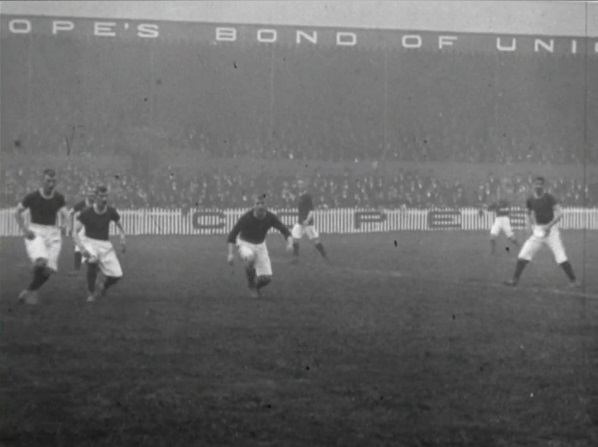
Little had happened with the ground over the last seven/eight years. There is a footage of Liverpool playing Burslem Port Vale at Anfield in 1901 on the net. You can see the footage by going here (note it is only visible for people living in the UK). Here is a few images from the video.
This first image show the kick off of the match. In the background you can see the Kemlyn road stand and the pipes of the houses in Kemlyn road.
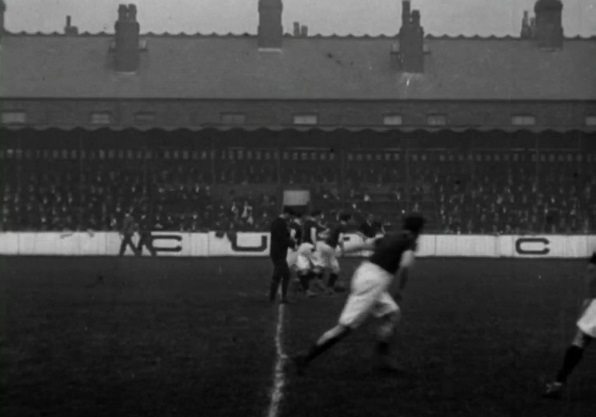
On the next image you can see the Main Stand in the background. The player in the middle bending down on his knees I believe is our captain back then, Alex Raisbeck.
 .
.
And what about this image from the video showing the supporters at either the Anfield road end, or the Kop End, or Oakfield road end as it was known then. Do you recognises the houses in the background?
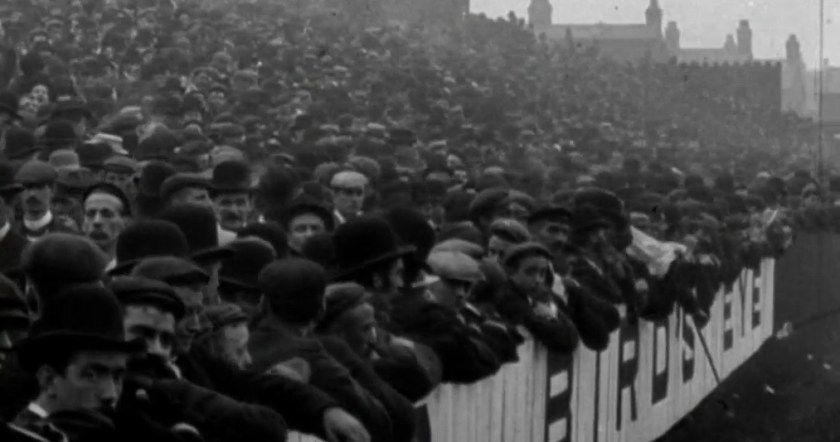
In October 1905 the “Liverpool Daily Post” told us that: –
“It is a matter of interest to point out that spectators at the Anfield ground will not be able to pay for admission for direct entrance on to the shilling stand, without having to pay through the sixpenny turnstiles as heretofore. The new entrance is in Orrell’s field, just behind the club offices.”
In January 1906 it was reported that the Liverpool club had become owner of the Anfield-road ground, having concluded negotiations with the owner, Sir William Houlding. The new owners hope is that by the beginning of next season to have an enclosure worthy of the new club.
Liverpool won promotion back to the first division immediately and the club collected its second first division title at the end of the 1905/06 season. In the run in we met Everton at Anfield in April 1906 and a new crowd record was noted. The “Liverpool Courier” reported this in their match report: –
“Fine weather, a holiday season, and keen partisanship combined to produce a record crowd at Anfield yesterday when the return League match between Liverpool and Everton was played.
“Indeed, the crush was so great that not only was the proper accommodation packed, but spectators encroached on the playing area.
“Fully an hour before the kick off the utmost capacity of the ground was tested.
“At half past two the dense and swaying crowd at the Oakfield-road end broke down the railings and surged on to the field.
“A staff of constables, kept the spectators behind the touch line, but shortly afterwards a similar incident occurred, and further avalanches of spectators poured on to the green.
“All round the playing pitch enthusiastic supporters of either club swarmed around the touch line.
“Others climbed on the roofs of the stands while several partisans swarmed up the pillars supporting the roofs and perched themselves in forks of the ironwork.
“The ground is supposed to hold 28,000 people, but there were probably 35,000 present, while thousands remained outside unable to gain entrance.
“Owing to the encouragement of the spectators on the playing area, which the police found utterly impossible to prevent, it was very doubtful whether the game could be concluded.”
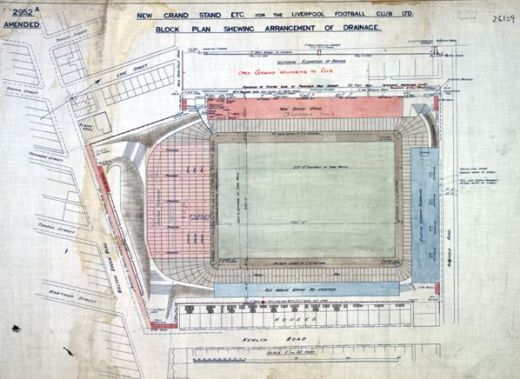
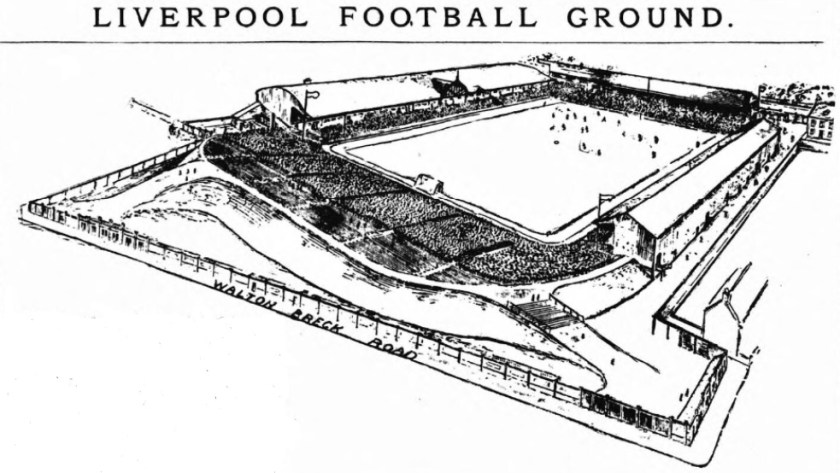
During the summer of 1906 the work started on building the new Anfield. I will finish this article with showing you three sketches.
The first one shows the ground as it was in May 1906.
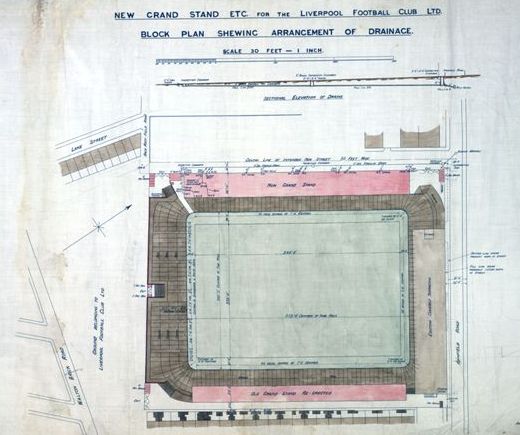
The next sketch shows what the new ground would look like when completed.
And when the 1906/07 season kicked off the “Liverpool Daily Post” had on print this sketch of new Anfield.
Sources for this article:
* The BNarchives online and its newspapers.
* Blue correspondent by Billy Smith.
* The history of Everton Football Club, by Thomas Keates, 1929.
* Everton F.C. – The men from the hill country, 2002.
* Football Field, December 28 – 1888.
* Liverpool Echo, Football Echo, November 16 – 1889.
* Cricket and Football Field, November 23 – 1889.
* Soccer History, issue 4 (17/03).
I would also like to thank Steven Horton for answering all my queries about old landmarks around Anfield.
 "Play Up, Liverpool"
It’s a wonderful article, Kjell. Congratulations!
Very informative article, Kjell. The photograph you assume is the Kemlyn Road Stand from the turn of the century is in fact the Main Stand under construction in 1895. It’s got the distinctive barrelled roof and paddock rear wall, which were features of the stand until it was enlarged in the early 1970s.
A point with land owner Orrell. As a part of the deal selling the land to Houlding, note that Orrell still owned the land to the north of the site, was a covenant in the contract that he could access his largely landlocked site by constructing a road through Houlding’s land, the land of the football ground rented by Everton FC. He gave notice he was to enact his right to construct an access road through the stand Everton FC had erected. This was the flashpoint that widened the rift between Houlding and the Everton Committee which eventually led to the split at Everton creating Liverpool FC.
The issue of the rent, which was ongoing and under negotiation, was minor to the point of the access road. The Everton FC committee did not know of this clause in the land deal and suspected collusion of Houdling with Orrel. Houlding did make it clear he wanted to purchase Orrell’s land, to construct a large football and athletics ground to use also in summer. Distrust set in. Indeed Orrell tried to build his road after Liverpool FC was formed, proving that Houlding was not colluding with Orrell on this point. Liverpool FC did consider moving to another location.
Indeed Liverpool FC has the name “athletic” in the title, reflecting the envisioned summer athletics side of the ground. Houlding registered “Everton FC and Athletic Grounds Ltd” after the split saying he was still Everton. He told he could not use the name Everton and substituted Liverpool for Everton in the company registration.
Hi Michael,
Thanks for visiting and leaving such a valuable comment. The early months of our clubs is exciting for any historians and loads of articles has been written.
Not sure if you have seen the article I wrote on the matter? http://kjellhanssen.com/the-history-of-liverpool-fc/
Regards,
Kjell