Wednesday, April 29 – 1914
Till within a year ago the name of the “Latin Quarter” of Liverpool was truly deserved by the tangle of streets lying between Islington and Richmond-row. Now not more than fifteen families remain, and these last fluttering motes of colour of what was once a bright and picturesque Italian colony are steadily sinking into the gloom of the surrounding slumland.
Detroit, the modern Utopia, has been the magnet which has attracted the others away. A letter or two describing the splendour of American life came from Italians who had found their way to Lake Michigan. Bartalemea and Pictro, two wise Tuscani, were sent forth from Liverpool as pioneers, and in a short time afterwards took place the great trek which has left our city with one spark less of the colour which makes her streets so unlike those of any other city in England.
Other Occupations.
The organs still dome down Gerard-street every morning, and are wearily trundled up the hill to harbour every evening; but the velvet vest and scarlet sash of the Piedomonteso is missing. Fiametta or Petronilla, with her purple velvet gown, white bodice, coral beads, and green veil, has gone, and the patient-faced old woman who stood switch in hand behind her canary cage, a Sybil whose wrinkles shone like mahogany, or the sturdy matron with the amber-brown babies, who sang “Santo Lucia” in a contralto that drowned all accompaniment, has gone along with her.
Apart from the great migratory movement westwards, there has also been for years a steady assimilation with surrounding elements and a trend towards other more English vocations. Young Italians have dropped the shafts of the organ and turned aside from sculpture for the prospering bustle of public house management, the milder air of the milkhouse, or the odourous atmosphere of the chip shop.
Fresh immigration, however, previously always made up for these leakages; but now that has ceased, and the life of the local “Little Italy” is fast becoming a tradition.
Why She Remains.
“Why at one time o’day,” said a sharp-eyed Irishwoman to me from the throne of her own doorstep, “if you went to St. Joseph’s, in Grosvenor-street, of a Sunda’ mornin’ you’d see nothin’ before you but black heads. Now they are nearly all gone, but, “she added in a lower key, “there’s one that will never go away at all. There she is now, across the road,” and I looked to see Carita, a tall, grave-looking woman with Murillo-type of features, pass with faint, lingering steps into her own house. “That’s her nephew, that young man sittin’ ondher the winda smokin’. He’s off in a day or two and when he goes she’ll have no one. But ‘tis no use debatin’ with her, she’s been coaxed and coaxed, but go she won’t.
“An’ ‘tis all over a child she lost – a little boy that’s buried here. You have only got to look at her to see that half the life of her is in the grave with him. ‘Tis Fillipo, Fillipo in her mind and heart everlasting’, and she finds the greatest contentment at all in knowin’ she’ll be laid with him.”
“America,” said the nephew, to whom I passed a match a little later, and who it was clear prided himself on his giant strides in the tongue of Milton, “yes, I go nexta wick. All our pipple go, but Carita,” and he waved his cigarette towards the house. “No use spik to her, she’s a sticker. She live here, becos to daie here. Bah!”
(Liverpool Echo, 29-04-1914)
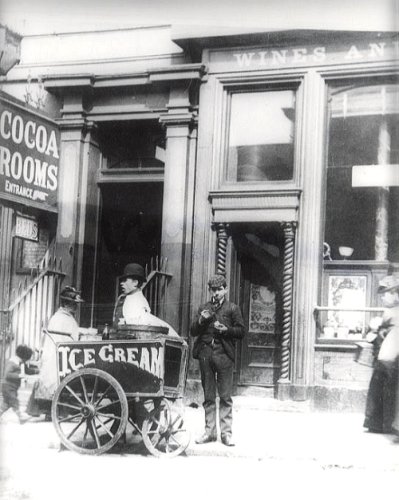
Little Italy, around 1900.
 "Play Up, Liverpool"