March 10, 1923
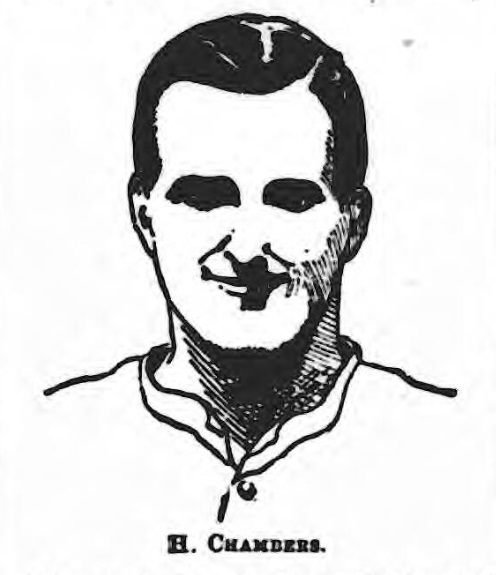
On the way to goal, by Harry Chambers (The famous Liverpool and English international inside left).
There are many different ideas on the best methods which can be employed on the way to goal. Some football teams believe in the short-passing game, which means that progress is made by quick transfers of short length from one player to the other. In this method an attack which is started on one wing is, as a rule, developed along that wing.
By way of contrast to the short-passing game there is the long-passing movement as a way to goal, the ball being swung about from one wing to the other, and headway being made at break-neck pace.
One often hears the former type of forward play described as the real science of football, while the long-passing game seldom gets any such description. But, for my part, I doubt whether this sort of summary is completely justified. Obviously it takes a clever lot of players to beat the opponents by accurate short passing, and certainly this type of forward play, well done, has a right to the term scientific. But, on the other hand, it requires pretty nearly as much science to do the long-passing game well as it does for the short-passing game. The trouble is that the long-passing game, indifferently done, becomes a mere matter of kicking the ball hard and running after it at top speed. This, however, can scarcely be called passing at all: it is just haphazard trust-to-luck kicking.
It is, of course, absolutely impossible to lay down hard and fast rules as to the methods which are more successful on the way to goal – or as to the methods most likely to produce goals. Everything depends on the individual capabilities of the players concerned, and on their effectiveness as a line. Just to give on instance, unless you have pace on the extreme wings the long-passing game would scarcely pay. Recent successes of the Liverpool side line may have led people to believe that we have discovered the secret of success on the way to goal, and consequently I may be expected to be able to tell my readers just how we do it. But I am not going to suggest that it can be done by the forwards of every club, and, what is more, I am not even going to hint that the same tactics will always lead the Liverpool club to victories.
Perhaps more than to anything else does the success of a forward line depend upon the blend, and the secret of the success of Liverpool, so far as the forwards are concerned, is that by good fortune or by good management, or possibly some of both, we have at the moment an effective blend. If it is true in any sense that variety is the spice of life, then I should say that variety is the spice of life for the forward line of a football team; and I am convinced that a great deal of the success of the Liverpool side in recent months is due to the fact that we have not tied ourselves down to any particular method either of attack or defence. We have given our opponents the variety which has caused them to think, and which, to a certain extent, has prevented them from settling down to any definite line of campaign as a counter-blast.
For the most part, I suppose that the forwards of Liverpool at the present time might be said to play the open game. Certainly it is our object always to keep the ball moving on the way to goal, and with this end in view we often shift the scene of operations from one wing to another. The more I see of football the more I am convinced that, so far as forward play is concerned, there is no more effective move than the swing from the inside-left to the outside-right, or from the inside right to the outside-left.
So important is this phase of operations that I think it worth-while to stop for a moment to examine its possible effects. Let us imagine than an attack is being developed on the left wing. The defenders come over to prevent the opposition getting too near, and if the right-half and the right back been beaten, the left back must come over. So you see that by this time the defence is concentrated on the wing where the ball is for the time being. But suppose the inside-left suddenly takes a big kick at the ball and swings it over to his right, the probability is that the player there will be standing quite unmarked and in a fine position for carrying on the good work. As a general rule we may take it that the obvious pass is the bad pass; it is the surprise move which gets the defenders guessing.
It is no part of my business here to make any sort of comparison between the individual members of the Liverpool forward line. I have already hinted that the great thing to get in order to achieve success in the goal-scoring lines is the proper blend, and the proper blend consists in sufficient pace and sufficient cleverness to get the better of opposing defenders, and in sufficient “punch” at the finish to drive the ball past the goalkeeper.
But always – and this is one of the important things which count – it should be borne in mind by the players of any football team that it does not matter a bit who scores the goals so long as the goals are scored. I know that in these days we see lists published in the newspapers of the people who are most successful in the net-finding line, but oft-times I wish we could do away with these statistics. However, I suppose the people like to read them.
A moment’s reflection, though, will serve to show that they really prove nothing, simply because they take no account of the work of the man who made the opening for the goal. Sometimes the man who scores is deserving of the credit, because he may get through as the outcome of a brilliant individual effort and a good finish. But just as often – nay, even more frequently – it is some player other than the goal-scorer who works out the chance.
With any side which hopes to be successful it must be the team first and foremost and all the time. If the team comes through, then it doesn’t matter who does the scoring.
At the present moment I believe that one of the reasons why the Liverpool forward line is meeting with a fair amount of success is that we have developed the art of doing things quickly. This does not mean that every man in the forward line is an express; the pace at which a player can run has precious little to do with fast football.
But we do believe in getting on with it, in keeping the ball moving goal-wards, and cutting out, as far as possible, the fancy twists and turns which so often leave the player no better off than when he started.
(Source: The Fife Free Press: March 10, 1923)
Harry Chambers, Liverpool F.C.
XX
 "Play Up, Liverpool"